Live competition / 2026
RedLine Predictor
A long-running family competition became a serious product-design problem.
Why I built it
The competition had been running manually for years. Earlier attempts to turn it into software stalled against authentication, data, notifications and the sheer friction of implementation. AI changed what was practical.
The product
Making the premise tangible.
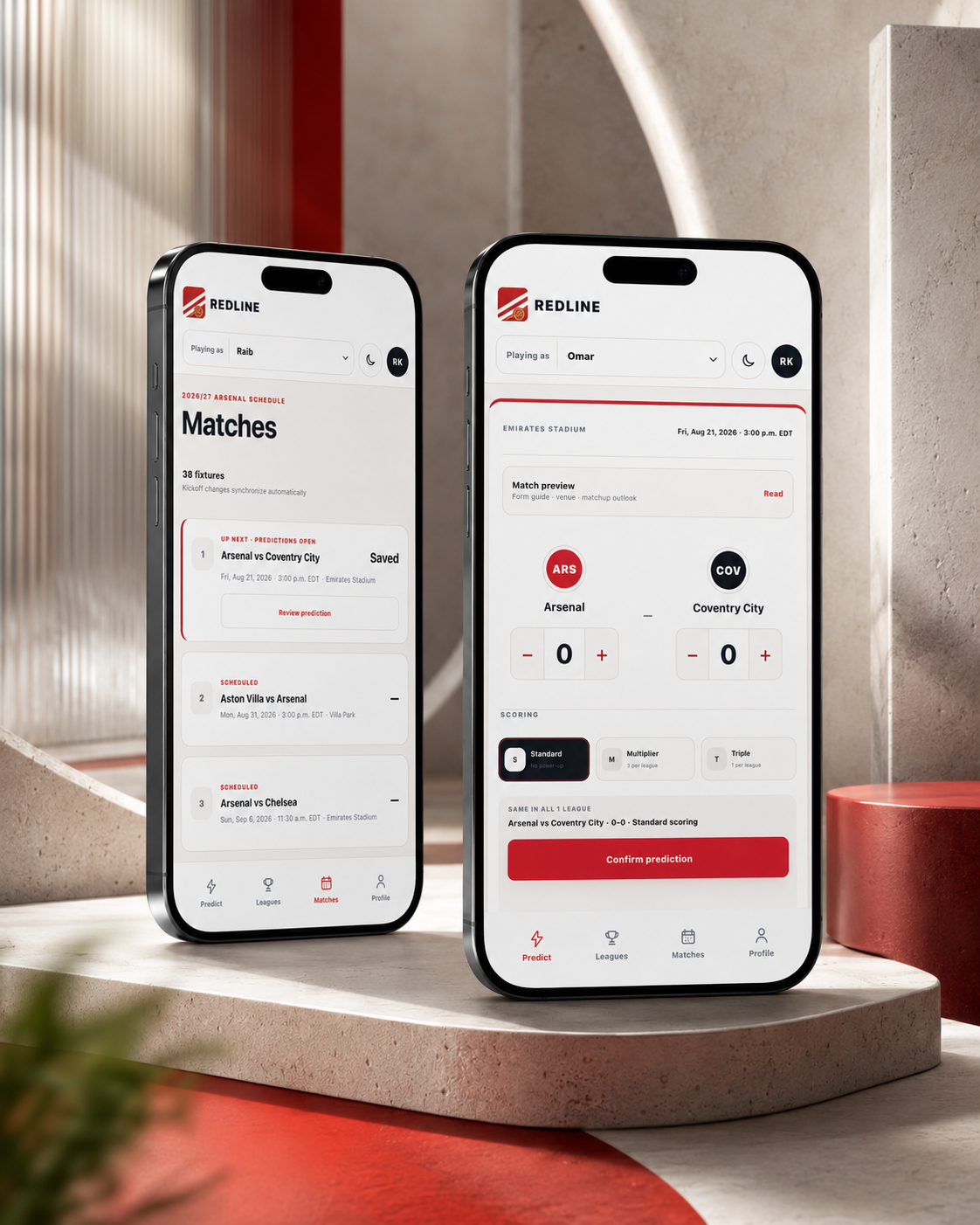
RedLine supports fixture predictions, private leagues, custom scoring, power-ups, automated fixtures and results, reminders, historical tables and managed players. Predictions lock at kickoff and remain hidden beforehand to protect the competition’s integrity.
How it evolved
The thinking behind the build.
Translate a six-year ritual
The rules lived in messages, memory and accumulated competition history. Before designing screens, we had to make the unwritten logic explicit: when entries lock, what other players can see and how every scoring variation behaves.
The happy path hid the real product
Predictions and a league table were only the surface. Power-ups, hidden picks, managed players and kickoff integrity turned the build into a real rules engine rather than a polished form.
UAT became the roadmap
Real rounds exposed stale cached pages, standings discrepancies, reminder gaps and ambiguous states. Each issue fed back into the rules, interface and data model until the product could be trusted on matchday.
The product / In context
Key decisions
Where product judgement showed up.
- 01Treat kickoff as a hard integrity boundary
- 02Design power-ups for upside and downside
- 03Support managed players without weakening privacy
- 04Preserve historical competitions while rebuilding the experience
My role / AI’s role
I owned the rules, requirements, scoring logic, product decisions, UAT and edge cases. AI assisted across implementation and debugging, but real competition history and user testing determined whether the product was correct.
Iteration
The first build was the beginning.
UAT exposed the work hiding beneath the main flow: stale pages around kickoff, mismatched standings, mobile spacing, unclear prediction states, reminders and edge cases for people who had not submitted. Those details turned a prototype into a credible product.
What I learned
- A scoring system is a rules engine, not just a table.
- Private products still need serious trust, privacy and reliability decisions.
- The last stretch is dominated by edge cases that a happy-path demo never reveals.