Browser game / 2026
Orbit
Release at exactly the right moment. Miss, and disappear into space.
Why I built it
Orbit began with a deliberately small challenge: could a one-input mechanic be understandable in seconds, satisfying on both mobile and desktop, and interesting enough to replay?
The product
Making the premise tangible.
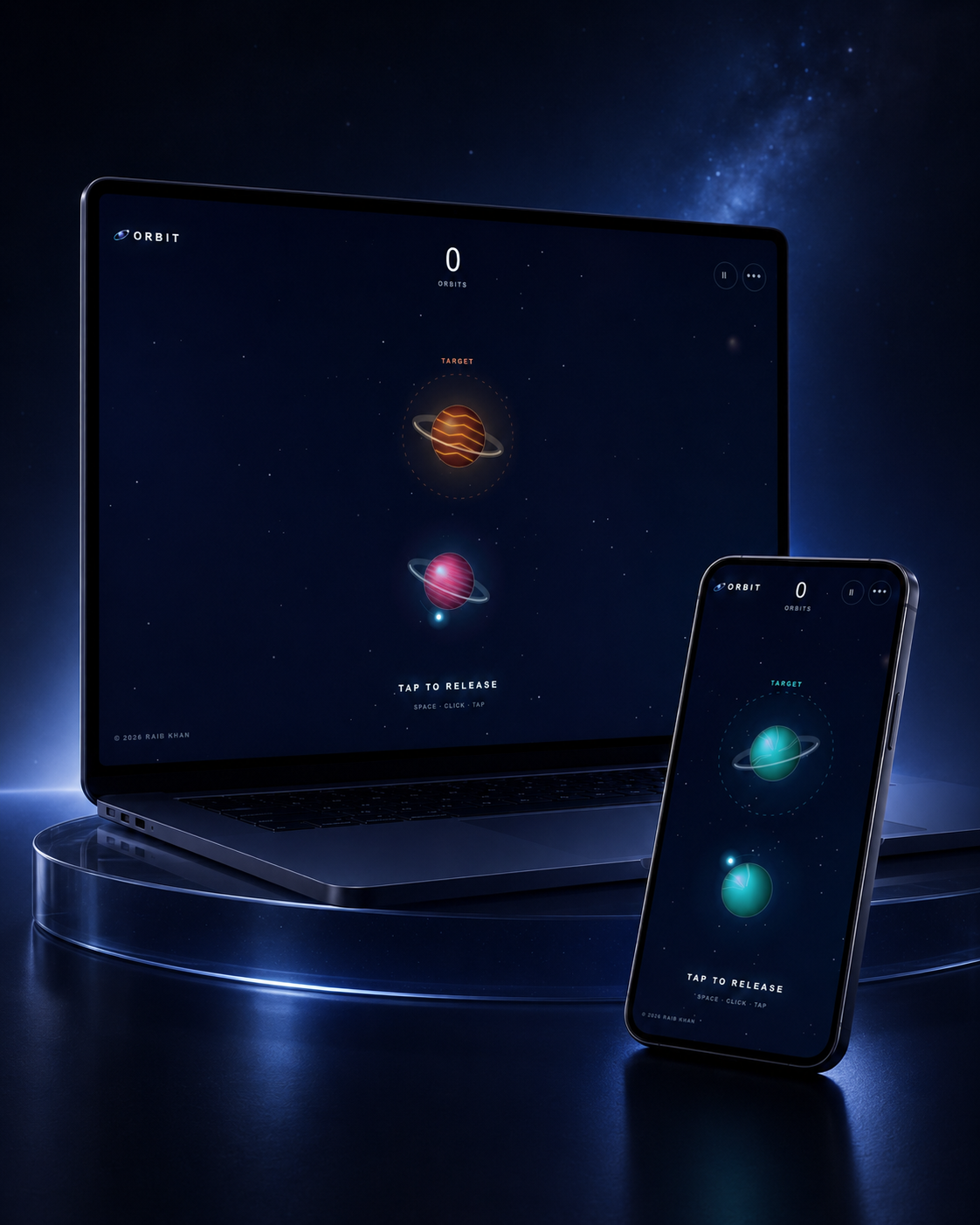
The player releases a satellite from one planet and uses timing, gravity and momentum to reach the next. The control is simple; the changing geometry creates the difficulty. Fast restarts keep failure light and the loop immediate.
How it evolved
The thinking behind the build.
The mechanic came before the world
The earliest question was whether releasing a satellite from one orbit could be understood without explanation. We kept the input singular and the feedback immediate, then built the visual world around that loop.
A working loop was not enough
Early builds technically worked, but misses felt uneven and mobile timing lagged behind desktop. Repeated play-testing shifted the work toward challenge tuning, touch responsiveness, fair failure and a restart that never interrupts momentum.
Character without clutter
Planets, comets and background movement arrived only after the mechanic held up. Each addition had to make the game feel more alive without making the next move harder to read.
The product / In context
Key decisions
Where product judgement showed up.
- 01One input across touch, mouse and keyboard
- 02A five-second learning curve without a long tutorial
- 03Fast failure and immediate restart
- 04Enough visual restraint for the mechanic to remain legible
My role / AI’s role
I set the product vision, mechanic, requirements and quality bar, then used AI as a technical execution partner across design, frontend implementation, procedural behaviour, responsive interaction, tuning and QA.
Iteration
The first build was the beginning.
The first useful build proved the mechanic. The work after that was product work: tuning challenge, smoothing interaction, strengthening mobile behaviour, adding visual character and removing anything that slowed the loop.
What I learned
- A tiny mechanic can support a real product when the feedback loop is sharp.
- Game feel is mostly iteration, not the initial idea.
- AI shortens the path to a working build; judgement still shapes what survives.